
Night diving in Okinawa: nocturnal creatures, shore dives, and lighting gear
📅 2026-10-11
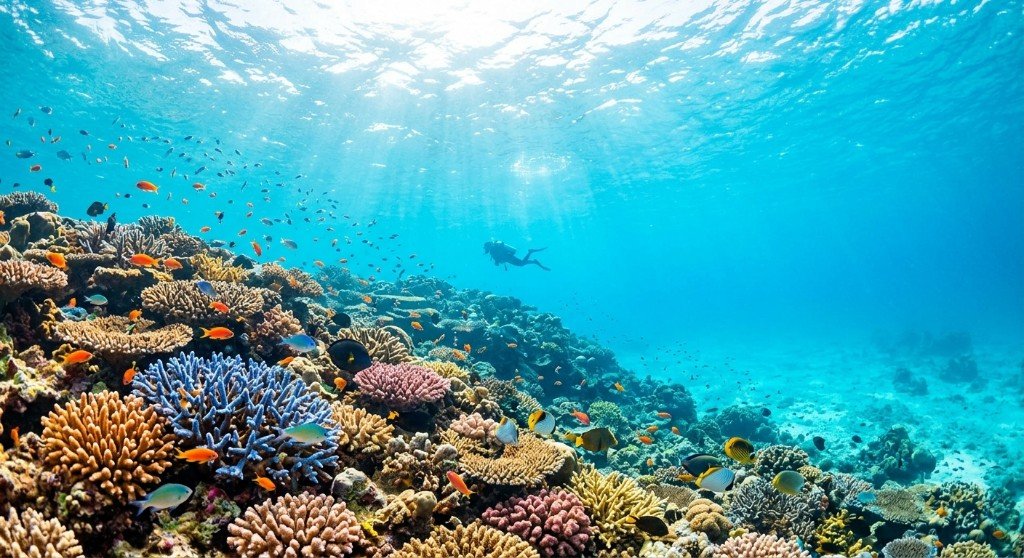
Okinawa by day is postcard turquoise. Okinawa by night is a different ecosystem entirely — and that's exactly the draw for divers who've already logged their daytime reef dives and want to see what actually comes out when the light disappears.
Who night diving in Okinawa is really for
This isn't a first-dive activity, and it isn't meant to be. A night dive asks more of you than a daytime reef dive: you're navigating by torch beam, your depth perception narrows to whatever's lit in front of you, and buddy contact depends on hand signals and light signals instead of eye contact across open water. Most operators in Okinawa want to see Open Water certification plus at least 10–15 logged dives before they'll take you on a night dive, and some request an Advanced Open Water card or a specific Night Diver specialty, especially for sites with any current.
What makes Okinawa specifically good for this, rather than just "a place where you can also dive at night," is the sheer density of nocturnal macro life on its fringing reefs. The reef flats around the main island and the Kerama Islands are shallow, current-light, and packed with crevices — ideal conditions for the octopus, cuttlefish, and crustaceans that hide all day and hunt at night. Add in Okinawa's long tradition of uminchu (sea people) fishing culture, where reef knowledge was passed down as survival skill, and local dive guides here tend to have an unusually sharp eye for where things hide. Ask your guide what they've seen on recent night dives — in this region that question usually gets a specific, useful answer rather than a generic one.
Conditions: shore entry sites, reef layout, and what's actually down there
Most Okinawa night dives are shore dives, not boat dives, and that's a feature, not a limitation. A shore entry means you can abort or adjust the dive on your own schedule, there's no boat schedule pressure, and the sites tend to be shallow (5–12 meters) reef flats that are forgiving if visibility drops or someone's trim gets wobbly in the dark.
Typical layout at a classic Okinawa night shore entry: a sandy or rubble entry point, a short surface swim or walk-in over shallow reef flat, then a drop onto a coral slope or wall where the real nocturnal activity concentrates. Guides generally brief the exact route in daylight first if it's your first time at that site — walking the entry and exit points before the sun goes down removes most of the risk that trips up new night divers, since the same reef that's easy to read at noon looks completely different under a 6,000-lumen torch beam.
What you're looking for, in rough order of excitement:
- Nocturnal mollusks: day octopus and various cuttlefish species become far more active and visible after dark, often hunting out in the open rather than wedged in a hole.
- Crustaceans: slipper lobsters, spiny lobsters, and decorator crabs come out of reef crevices that are empty in daytime photos.
- Macro life: this is where the night dive earns the "macro" reputation — nudibranchs, shrimp (including mantis shrimp on sandy patches), and juvenile reef fish that shelter in coral polyps during the day are all far easier to spot at night when they're moving.
- Bioluminescence: on a dark-moon night with no surface light pollution, disturbing the water with a fin kick or a hand wave can trigger a visible glow from dinoflagellates in the water column — turn your torch off for thirty seconds mid-dive and let your eyes adjust to see it.
Okinawa's reef structure (shallow fringing reef, drop-off, sandy channel) means most sites have a built-in natural boundary that makes night navigation simpler than it sounds: follow the reef edge out, follow it back in, and you're rarely more than a few fin kicks from a known reference point.
Season and access: when to go and how to get there
Okinawa dives year-round, but night diving specifically rewards timing around two variables: water temperature and moon phase.
Season window: May through October gives the warmest water (26–29°C) and the calmest seas, which matters more at night than during the day since rough surface conditions make a shore entry/exit in the dark genuinely risky. November through April the water drops to 20–24°C, which is still diveable in a 5mm wetsuit but adds another layer of gear management in low visibility. Typhoon season peaks August–September — operators cancel night dives first when there's any swell forecast, so build a buffer day or two into a late-summer trip.
Moon phase matters more than people expect: new moon nights give the darkest water and the best bioluminescence response, since there's zero ambient light competing with your torch or with the plankton glow. Full moon nights are actually easier for navigation (some ambient surface light filters down in shallow water) but wash out the bioluminescence effect. If seeing a glowing wake is your priority, book around the new moon; check a lunar calendar before locking your dates.
Getting there: Naha Airport on Okinawa's main island is the hub — direct flights run from Tokyo (Haneda/Narita, about 2.5 hours), Osaka (around 2 hours), and several other domestic cities, plus direct international routes from Taipei, Seoul, and Hong Kong. From Naha Airport, most of the main island's shore dive sites (Chatan, Onna, Cape Maeda) are a 30–60 minute drive, and a rental car is genuinely the easiest way to manage a night dive schedule since you're not relying on buses that stop running early. If you want to reach the Kerama Islands, which have noticeably clearer water and less light pollution, you'll take a ferry (35–50 minutes from Naha's Tomari Port) or a shorter flight from a regional airport, and most Kerama operators run night dives from a shore base on Zamami or Tokashiki rather than from the boat.
Practical tips: booking, lighting gear, and etiquette
Booking: Reserve a night dive at least a few days ahead in peak season (June–August), since Okinawa operators cap night dive group sizes smaller than day trips — often 2–4 divers per guide rather than 6–8 — precisely because low-visibility supervision is harder. Confirm certification requirements when you book; showing up without the logged dives an operator requires means you'll be turned down on-site, not just discouraged.
Torch gear: this is the one category worth not cheaping out on. You want two lights, not one — a primary torch (minimum 1,000 lumens, ideally 2,000+) for navigation and lighting your path, and a backup light clipped where you can reach it one-handed if the primary fails. A failed primary light with no backup is one of the most common reasons a night dive gets aborted early. A narrow-beam primary throws light further and is better for navigation; a wider-beam secondary or a dedicated macro light is better for actually illuminating a nudibranch or shrimp without blasting it into a washed-out white blob in your photos. If you're shooting video or photos, a separate small "focus light" with a red filter is worth packing — red light doesn't spook nocturnal creatures the way a full-white beam does, so you get a few extra seconds before they retreat into the reef.
Signal lights: beyond your dive torch, carry a small strobe or chemical light clipped to your tank or BCD so your buddy and guide can track your position peripherally without needing a torch beam pointed directly at you the whole dive. Standard light signal etiquette applies — a slow circular sweep means "OK," rapid side-to-side means "come here" or "attention," and never point your beam directly into another diver's mask.
Etiquette underwater: resist the urge to grab or corner anything you find — Okinawa's reef macro life is already stressed by heat-driven bleaching events in recent years, and a night dive's whole appeal depends on animals continuing to behave naturally rather than learning to flee torch light. Keep your beam moving rather than fixed on one animal for more than a few seconds, and if you're in a group, let whoever spots something first get the first look before everyone's lights converge on it.
On land: Okinawa's dive culture runs more casual than mainland Japan — post-dive, look for an izakaya near the dive shop serving Okinawa soba and awamori, the local distilled spirit, which most shops will point you toward since it's as much a part of the post-dive ritual here as the dive itself. If you're staying near Onna or Chatan on the main island, basing yourself there rather than in Naha city cuts your pre-dawn and post-dusk drive times significantly, which matters more for night diving than for any other dive schedule.
Was this page helpful?
Your feedback helps us improve our guides