
Shiga Kogen Explained: A First-Timer's Map to Japan's Biggest Ski Complex
📅 2026-09-28
Why Shiga Kogen Is Different From Any Other Japanese Ski Trip
Most visitors to Japan pick one resort, learn its lifts, and stick to it for the trip. Shiga Kogen refuses that logic. It's not a single ski area — it's a sprawling collection of connected zones spread across a high plateau inside Joshinetsu Kogen National Park, all covered by one shared lift ticket. Depending on how you count, there are 18 to 21 distinct ski areas here (Ichinose, Yakebitaiyama, Okushiga Kogen, Yakushidake, Sun Valley, Higashidate, Nishitateyama, Terakoya, and more), threaded together by lifts, gondolas, and a few short shuttle-bus hops.
This matters for who should come here. Shiga Kogen rewards travelers who like exploration over convenience — skiers and boarders who get bored lapping the same run and want a mountain complex big enough that you genuinely cannot ski it all in a week. It's less ideal for families wanting a single, compact base with everything in walking distance (Hakuba's Happo-One or Nozawa Onsen are simpler for that). It's also a legitimately historic place: Shiga Kogen hosted alpine skiing and other events during the 1998 Nagano Winter Olympics, and Japan's oldest ski areas here date back to the 1920s, giving the place a lived-in, slightly old-school character rather than the polished newness of some purpose-built resorts.
If you're the type who studies a trail map like a puzzle, Shiga Kogen is one of the most satisfying multi-area systems in Japan — arguably its largest connected ski complex by both terrain and lift count.
How the 21 Areas Actually Connect
The single biggest adjustment for first-timers is mental: stop thinking "which resort" and start thinking "which zone of the complex am I in right now." The 21 areas cluster into a few practical groups:
- The core connected loop — Ichinose Diamond, Ichinose Family, Yakebitaiyama, Sunvalley, and Yamanohara link directly by lift, forming the busiest, most beginner-friendly heart of Shiga Kogen. This is where most first-day skiers should start.
- Higashidate and Nishidate (Boyaike) — connected to the core loop but with steeper, more varied pitch, popular with intermediate and advanced skiers looking for fewer crowds.
- Yakushidake and Shiga Kogen Prince Hotel areas — accessible via the Yakushidake Ropeway, offering some of the best tree-skiing and off-piste terrain in the complex, especially after a fresh dump.
- Okushiga Kogen — geographically separate; you'll need the shuttle bus to reach it, but it's worth the trip for uncrowded groomers and a quieter, more scenic vibe.
- Terakoya, Kumanoyu, and Ryuoo (Yakebitaiyama-adjacent zones) — smaller, often overlooked pockets with excellent snow quality precisely because fewer people bother to find them.
Practical navigation tip: pick up (or photograph) the full trail map at any ticket window before your first run. Areas are connected by specific lifts, and going the wrong direction can strand you a shuttle-bus ride from your hotel. Free shuttle buses run a loop route connecting the areas that aren't lift-linked (notably to/from Okushiga Kogen), running roughly every 15-30 minutes during operating hours — build buffer time around this if you're chasing terrain across the far ends of the complex.
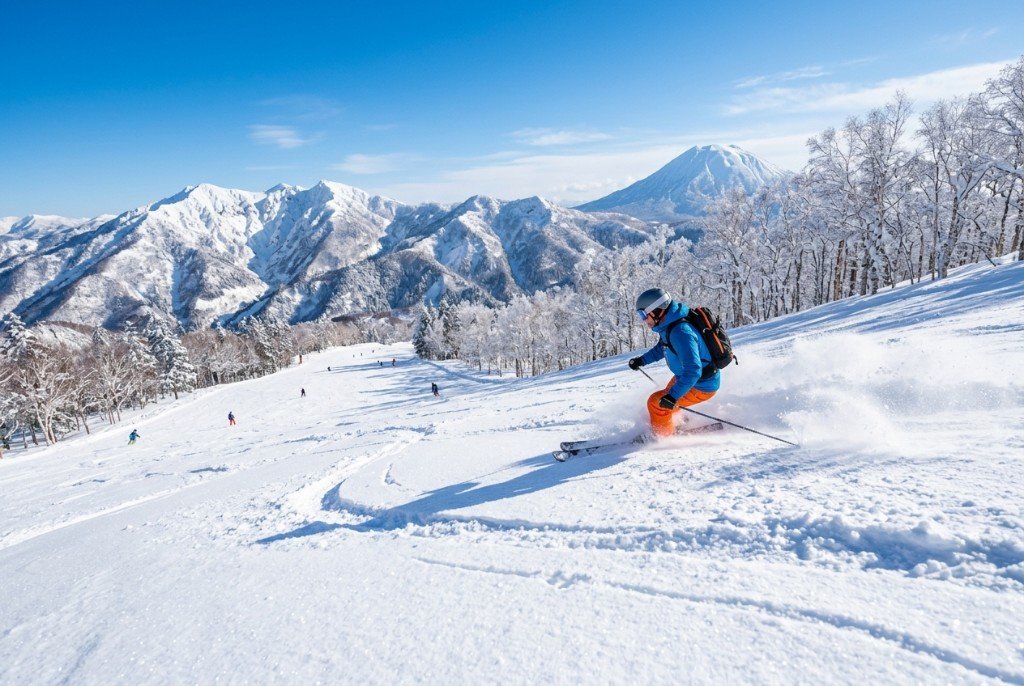
Terrain-wise, Shiga Kogen leans toward long, wide, well-groomed cruisers in its core zones, with genuinely challenging steeps and tree runs concentrated around Yakushidake, Higashidate, and the upper mountain sections. Snow quality is consistently excellent — Shiga Kogen sits at higher elevation (base around 1,340m, top around 2,110m) than most Nagano resorts, which means colder temperatures and drier, lighter snow later into the season than lower-elevation areas nearby.
Season and Access: When to Go and How to Get There From Tokyo or Nagano
Season window: Shiga Kogen typically operates from early December through early May, one of the longest seasons of any Japanese ski area thanks to its elevation. Peak powder conditions run mid-January through February. Late-season visitors (April) can find corn snow and still-open lifts long after lower resorts have closed — a genuine advantage if your travel dates are flexible and you want to avoid Lunar New Year and Golden Week crowds.
Getting there from Tokyo:
- Take the Hokuriku Shinkansen from Tokyo Station to Nagano Station (roughly 80-90 minutes).
- From Nagano Station, transfer to a direct bus to Shiga Kogen (about 70-90 minutes depending on which of the 21 areas you're headed to first — buses typically stop at multiple points through the complex).
Total door-to-slope time from central Tokyo is realistically 3.5-4.5 hours, making Shiga Kogen a feasible day trip in a pinch but far better as a multi-night stay given how much terrain there is to cover.
By car: Renting a car in Nagano and driving up (about 1-1.5 hours) gives you the most flexibility for hopping between the more spread-out zones like Okushiga Kogen without waiting on shuttle timing — but winter mountain driving requires snow tires or chains and confidence on switchbacks, so it's not for everyone. Parking is available at most base areas, often included or cheap with your lift ticket.
Nearest airports: Narita and Haneda in Tokyo are the standard international gateways; from either, the shinkansen-plus-bus combo above is the most reliable route. There's no airport meaningfully closer to Shiga Kogen itself, so budget the full transfer time from Tokyo regardless of which airport you land at.
Booking, Passes, and On-Mountain Etiquette
Lift tickets: The core value proposition of Shiga Kogen is its all-area pass — a single ticket valid across all connected zones, sold in half-day, full-day, and multi-day formats. If you're staying three or more days, the multi-day pass is essentially mandatory; buying single-area tickets defeats the entire point of a multi-area complex this size. Passes are available at any major ticket counter within the complex, and increasingly through online pre-purchase, which is worth doing during Japanese national holidays and weekends when counter lines get long.
Where to stay: Lodging is spread across the base areas rather than concentrated in one town like Hakuba's Echoland. Staying near Ichinose or Yamanohara puts you at the connected heart of the complex with the most lift access; staying at Okushiga Kogen trades some convenience for quiet and standalone charm. Many lodges are traditional, family-run pensions rather than large hotel chains — book early for peak season (late December through February), especially around Japanese New Year.
Onsen culture: This is a genuine highlight, not an afterthought. Shiga Kogen sits close to Jigokudani Monkey Park (famous for its snow monkeys bathing in hot springs) and the area is dotted with its own onsen ryokan. After a full day covering multiple zones, soaking in a local onsen is both the cultural experience and the practical recovery tool — plan for it, don't treat it as optional.
Etiquette and practical gear notes:
- Cover tattoos or check ahead at traditional onsen, as some still enforce no-tattoo policies.
- Bring or rent a printed/photographed trail map — cell signal is inconsistent across the more remote zones, and relying on a phone map alone across 21 interconnected areas is a common mistake.
- Rental gear is available at multiple points throughout the complex, but selection and sizing are better near the main base areas (Ichinose, Sun Valley) than at smaller satellite lodges.
- Food options are decent but simple — mountain-hut style noodle and curry shops dominate; if you have dietary restrictions, it's easier to stock up in Nagano city before heading up.
- Because the complex is so large, plan your day in loops rather than trying to "see everything" — pick two or three connected zones per day rather than chasing every one of the 21 areas in a single visit.
Shiga Kogen isn't a resort you master in one trip. Treat the scale as the feature: come back season after season and there's still another connected zone you haven't fully explored.
Was this page helpful?
Your feedback helps us improve our guides